Detection, comparison and a verdict you can open.
SECTORS
Factoring
Cheques arrive in batches, front and back. The fields read cleanly and the signature is the half still open.
Amount
read
Drawer
read
Signature
not checked
Banking
A signatory form is signed once. Every instruction that follows is checked against that one page.
Mark 1
Signer A
Mark 2
Signer B
Mark 3
no profile
Insurance
A claim is signed by the policyholder, or by somebody else. The form looks the same either way.
Similarity
61
Verdict
sent for review
WHAT ARRIVES
Built for the documents you actually receive.
Not the clean ones. The photographed, the folded, the scanned at an angle and the ones that arrive four hundred at a time.
Every signature detected, compared and decided.
UI AND API
Prototype in the UI. Scale with the API.
Use the Signature Verification console to enrol signers, tune thresholds and see exactly how a verdict was reached. Then move the same configuration to the REST API for production volume. Synchronous, asynchronous or batch.
Base URL is your own deployment. Endpoints and payloads are identical.
cURL
Copy
Python
Copy
INTEGRATION
Verify signatures inside the workflow you already run.
Signature Verification is one service in the platform. The same document that gets parsed, classified and extracted can be signature-checked in the same pass, and the verdict travels with the rest of the extracted data.
FAQ
Questions we get asked before a signature pilot.
Why not just compare the two images with a standard model?
Three reasons. A generic model scores visual likeness with no knowledge of how this particular person signs, so it cannot separate normal day-to-day variation from a different hand. It returns a number with no calibrated boundary, which means every team invents its own cut-off. And it gives you no record of what it compared against, so a disputed signature months later has no evidence trail. Writer-dependent verification against an enrolled reference cluster solves all three.
How many reference signatures does a signer need?
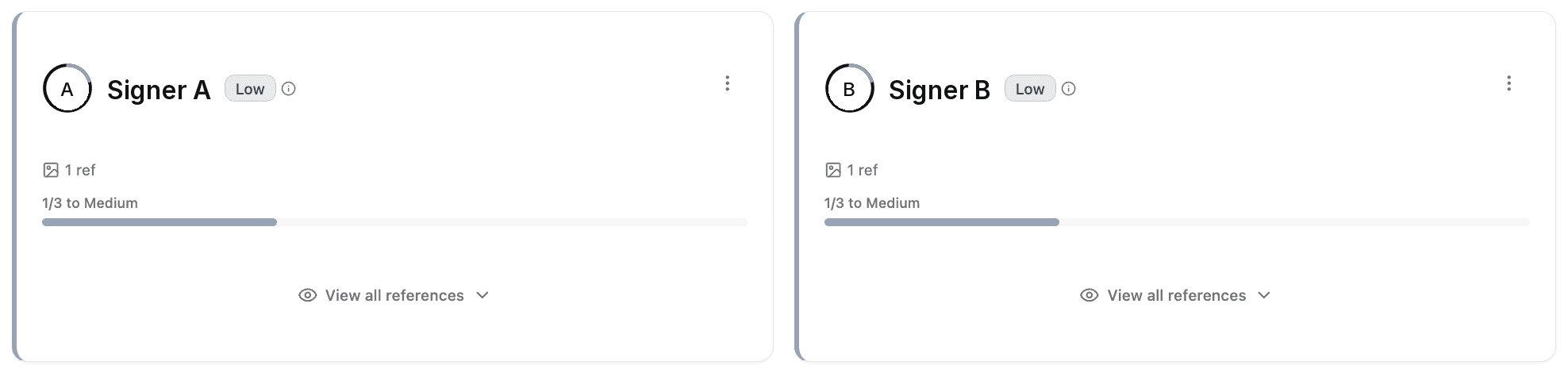
Three tiers, based on how many references are enrolled. One or two references is a Low profile. It is usable, but the comparison has little to calibrate against. Three references reaches Medium. Five or more reaches Verified, where the reference cluster is stable enough that a genuine variation and a different hand separate cleanly. You can start verifying at Low and strengthen the profile as more documents arrive; every accepted signature can be enrolled as a new reference.
What happens when the system can’t decide?
It says so. Between the Match and No Match thresholds there is a band where the honest answer is that the evidence is insufficient. That verdict is Inconclusive, and those signatures go to the review queue instead of being forced into a yes or a no. A reviewer sees the detected signature, the references it was compared against and every score behind the verdict. Only what the system could not settle on its own reaches a person.
Can it find signatures I didn’t tell it about?
Yes. Detection runs across the whole page before any comparison happens, so a signature in an unexpected position, such as an extra guarantor, an initial in a margin or a second page nobody flagged, is located and returned with its own confidence score and coordinates. In manifest mode you declare who should have signed and the system reports both missing signers and unexpected extra signatures. In open mode it simply reports everything it finds.
What file types and scan qualities are supported?
PDF, PNG, JPEG, TIFF and WebP. Scans arrive imperfect in practice, so the pipeline corrects for rotation and skew before detection, and flags low-contrast or low-quality crops rather than scoring them silently. A signature the system cannot read cleanly is surfaced as such instead of producing a confident-looking number from bad input.
Can thresholds differ per signer or per document type?
Yes, both. Match and No Match thresholds are set system-wide, then overridden per profile where a signer’s hand justifies it. A highly consistent signer can carry a stricter boundary than one whose signature varies. Verification templates carry their own configuration, so a loan agreement can demand more than an internal form. In the console you can drag the thresholds and see how the same evidence would have been decided, without changing the saved result.
Does any signature data leave our environment?
No. Signature Verification runs inside your infrastructure. The verification service, the reference store and the vector index are all deployed in your environment. Reference signatures and document images stay where you put them.
How do we prove a decision after the fact?
Every verification is stored with the evidence behind it: which references the signature was compared against, the similarity, cluster cohesion and centroid scores, the thresholds in force at that moment, and the resulting verdict. That record is retrievable per document and exportable as a report, so a signature disputed months later can be reconstructed as it was decided, not re-scored under today’s settings.
Start with one concrete workflow.
A document flow, a conversation line, an approval process. Live in weeks.