AI Adoption Challenges in Enterprises (And How to Solve Them)
Enterprise interest in AI has grown rapidly, but adoption is still more difficult than many organizations expect. While the technology continues to improve, the biggest barriers are rarely about the model alone. In most cases, the real challenge is operational.
Many companies start with strong enthusiasm, pilot one or two use cases, and then struggle to scale. The issue is not a lack of ambition. It is the gap between experimenting with AI and embedding it into real enterprise systems, workflows, and decision-making processes.
That is why understanding AI adoption challenges in enterprises is so important. Success depends not only on choosing the right AI tools, but also on solving the organizational, technical, and governance problems that come with them.
In this guide, we’ll break down the biggest adoption challenges and explain how enterprises can address them in a practical way.
Why Enterprise AI Adoption Is Harder Than It Looks
At first glance, AI seems easy to adopt. A team tests a model, sees promising outputs, and starts imagining wider use cases across the organization.
But enterprise environments are different from controlled demos. They involve:
multiple teams and stakeholders
legacy systems and fragmented data
security and compliance requirements
approval processes and governance controls
workflows that cross departments and tools
That complexity is what slows adoption. AI may work in isolation, but scaling it across a real enterprise environment requires much more than technical capability.
The Most Common AI Adoption Challenges in Enterprises
The barriers to adoption tend to appear in a few recurring areas.
1. Poor Integration with Existing Systems
One of the biggest problems is that AI often sits outside the systems where real work happens. If an AI system cannot connect to CRM platforms, ERP tools, ticketing systems, internal databases, or workflow engines, it remains disconnected from operations.
This leads to a familiar problem: the AI can generate outputs, but it cannot influence outcomes.
How to solve it:
Start with use cases that can connect to real workflows. Prioritize platforms or architectures with strong integration support, including APIs, event handling, and system connectors.
2. Weak Data Foundations
AI depends heavily on data quality, but many enterprises still struggle with fragmented, inconsistent, or poorly governed data environments.
If internal knowledge is outdated, customer records are incomplete, or process data is unreliable, AI performance becomes unpredictable.
How to solve it:
Do not treat AI as separate from data strategy. Improve data access, ownership, and governance early. Even modest data cleanup can significantly improve AI outcomes.
3. Lack of Clear Ownership
AI adoption often fails when no one clearly owns the initiative. Different teams may be involved—IT, operations, customer support, legal, compliance, and leadership—but without clear accountability, progress stalls.
This creates slow decision-making and unclear responsibility for results.
How to solve it:
Assign ownership at both the business and technical level. Enterprises need someone responsible for operational value, not just technical rollout.
4. Governance and Risk Concerns
Many enterprises hesitate to scale AI because of concerns around compliance, privacy, auditability, and model behavior. This is especially true when AI is connected to customer-facing workflows or operational decisions.
Without governance, leadership often sees AI as risky rather than scalable.
How to solve it:
Build governance into the rollout from the beginning. Define access controls, logging, approval rules, escalation paths, and acceptable use boundaries before AI reaches production.
5. Low Trust from Internal Teams
Even when the technology works, employees may not trust it. Support teams may worry about quality. Operations teams may question consistency. Leadership may doubt whether the system is safe enough to expand.
This trust gap slows adoption as much as any technical problem.
How to solve it:
Focus on transparency, explainability, and measurable results. Show where AI performs well, where humans remain involved, and how success is being monitored.
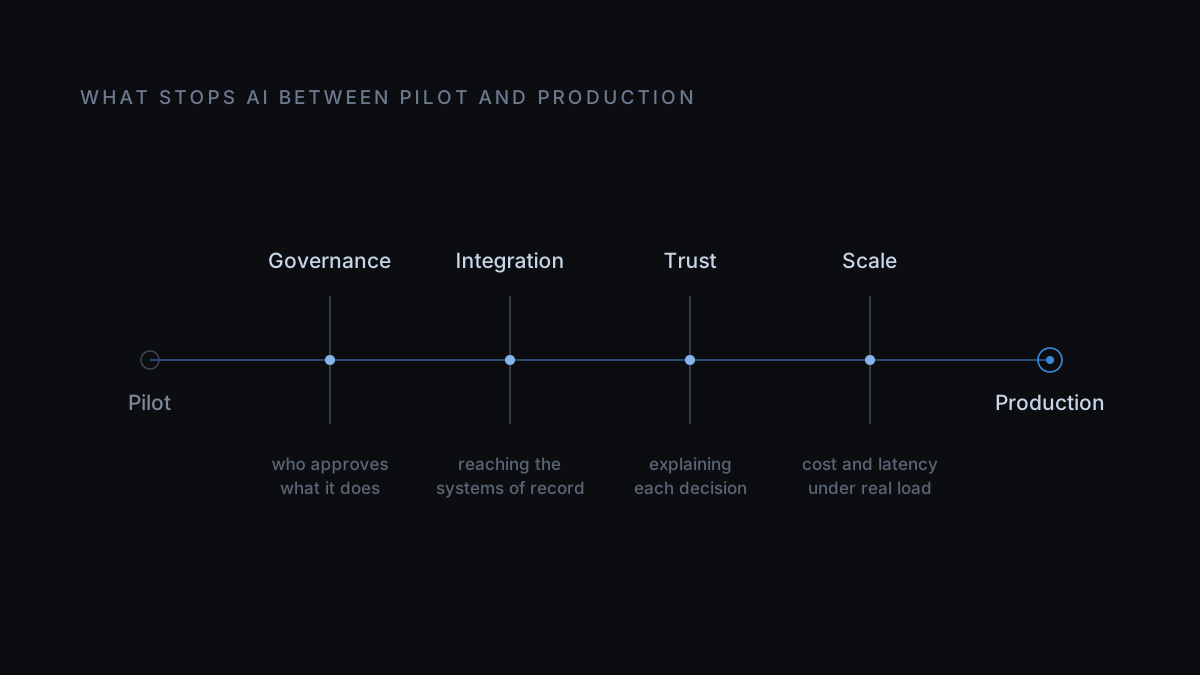
6. Difficulty Moving from Pilot to Production
Many AI projects perform well in a pilot and then struggle in real deployment. The reason is usually not the use case itself, but the lack of production readiness.
A pilot can work with limited traffic and loose controls. Production requires scalability, governance, monitoring, and system reliability.
How to solve it:
Design pilots with production in mind. Define success metrics early, plan integrations from the start, and treat observability and governance as part of the solution—not as later additions.
7. Unclear ROI and Business Value
Another common challenge is the inability to clearly explain what AI is improving. If the business case is vague, adoption tends to lose momentum after the initial excitement fades.
Enterprises need more than “AI potential.” They need measurable outcomes.
How to solve it:
Tie AI adoption to real operational KPIs such as handling time, workflow speed, cost per case, ticket deflection, resolution quality, or onboarding speed. Without outcome-based measurement, AI remains experimental.
A Simple View of Enterprise AI Adoption Barriers
Challenge | Why It Happens | How to Solve It |
Weak integration | AI is disconnected from core systems | Prioritize API-ready and workflow-connected use cases |
Poor data quality | Internal data is fragmented or unreliable | Improve data access, structure, and governance |
Lack of ownership | Too many stakeholders, unclear accountability | Assign clear business and technical owners |
Governance concerns | Risk, privacy, and compliance are unresolved | Build controls, approvals, and logging early |
Low trust | Teams doubt AI quality or consistency | Increase visibility, transparency, and measurement |
Pilot-to-production gap | Early success does not translate operationally | Design pilots with scale, monitoring, and governance in mind |
Unclear ROI | Value is not tied to business outcomes | Track operational and financial KPIs from the start |
How Enterprises Can Improve AI Adoption
While every enterprise environment is different, the most successful AI adoption strategies usually follow a few common principles.
First, they start with a workflow problem not a model.
Second, they focus on operational fit rather than novelty.
Third, they build trust gradually through measurable outcomes.
And finally, they treat governance, integration, and monitoring as core parts of the architecture.
This is what turns AI from a pilot into a repeatable capability.
The biggest AI adoption challenges in enterprises are rarely caused by the technology alone. More often, they come from disconnected systems, unclear ownership, weak governance, low trust, and the difficulty of operationalizing AI at scale.
The good news is that these challenges are solvable.
Enterprises that succeed with AI are usually not the ones moving fastest at the beginning. They are the ones building the right foundations: clean data, strong integration, measurable outcomes, and governance that supports scale.
That is what makes AI adoption sustainable.
Frequently Asked Questions
What are the biggest AI adoption challenges in enterprises?
The biggest challenges usually include weak integration, poor data quality, unclear ownership, governance concerns, low trust, and difficulty scaling from pilot to production.
Why do enterprise AI projects often fail after the pilot stage?
Many projects fail because pilots are not designed for production. They often lack integration, governance, monitoring, and a clear operational rollout plan.
How can enterprises improve AI adoption?
Enterprises can improve adoption by starting with real workflow problems, assigning clear ownership, strengthening data quality, and building governance into deployment early.
Is governance one of the main barriers to AI adoption?
Yes. Many enterprises hesitate to scale AI because of concerns around privacy, compliance, accountability, and auditability.
Why is trust important in enterprise AI adoption?
Internal teams need confidence that AI systems are accurate, safe, and measurable. Without trust, adoption slows even when the technology performs well.
How does poor integration affect AI adoption?
If AI cannot connect to CRM, ERP, support tools, or internal data systems, it remains isolated and cannot create meaningful operational value.
What role does data quality play in enterprise AI adoption?
Data quality has a major impact because AI systems depend on reliable, current, and well-governed information to produce useful outputs and decisions.
How should enterprises measure AI adoption success?
They should track workflow and business KPIs such as resolution time, cost per case, productivity improvements, automation rate, and customer experience metrics.
Who should own AI adoption in an enterprise?
Successful adoption usually requires both business and technical ownership, with clear accountability for operational outcomes and implementation.
Is slow AI adoption always a bad sign?
Not necessarily. In many enterprises, slower adoption reflects the need for governance, alignment, and operational readiness. Sustainable adoption is usually more important than fast rollout.


