Customer Support vs Customer Service: What’s the Difference?
Many businesses use “customer support” and “customer service” interchangeably.
They shouldn’t.
While both are essential to customer experience, they serve different purposes — and understanding the difference is critical for scaling operations in the AI era.
Let’s clarify what separates them and why the conversation is evolving beyond both.
What Is Customer Support?
Customer support is primarily focused on solving technical problems.
It is reactive by nature. A customer encounters an issue, reaches out, and the support team resolves it.
Common examples include:
Login or password issues
Payment errors
Software bugs
Integration failures
Product malfunctions
The goal of customer support is resolution.
It answers the question:
“How do we fix this problem?”
Support is typically structured around ticket systems, SLAs, and technical expertise.
What Is Customer Service?
Customer service is broader.
It covers the overall customer experience across the entire journey before, during, and after purchase.
It can be reactive, but it is often proactive.
Examples include:
Product recommendations
Order tracking
Returns and exchanges
Subscription changes
Onboarding assistance
The goal of customer service is satisfaction and long-term loyalty.
It answers the question:
“How do we help this customer succeed?”
Customer service focuses on relationships, not just resolution.
Key Differences Between Customer Support and Customer Service
Customer Support | Customer Service |
|---|---|
Technical issue resolution | End-to-end experience |
Mostly reactive | Reactive + proactive |
Ticket-driven | Journey-driven |
Problem-focused | Relationship-focused |
Short-term interaction | Long-term engagement |
Both are necessary. And both are evolving.
Why the Distinction Matters Today
The future of customer experience is not just about answering questions or guiding customers.
It is about executing intent.
Modern AI systems are moving toward orchestration connecting multiple systems to:
Detect intent
Gather contextual data
Make decisions
Trigger workflows
Update transactional systems
Close the loop automatically
Instead of:
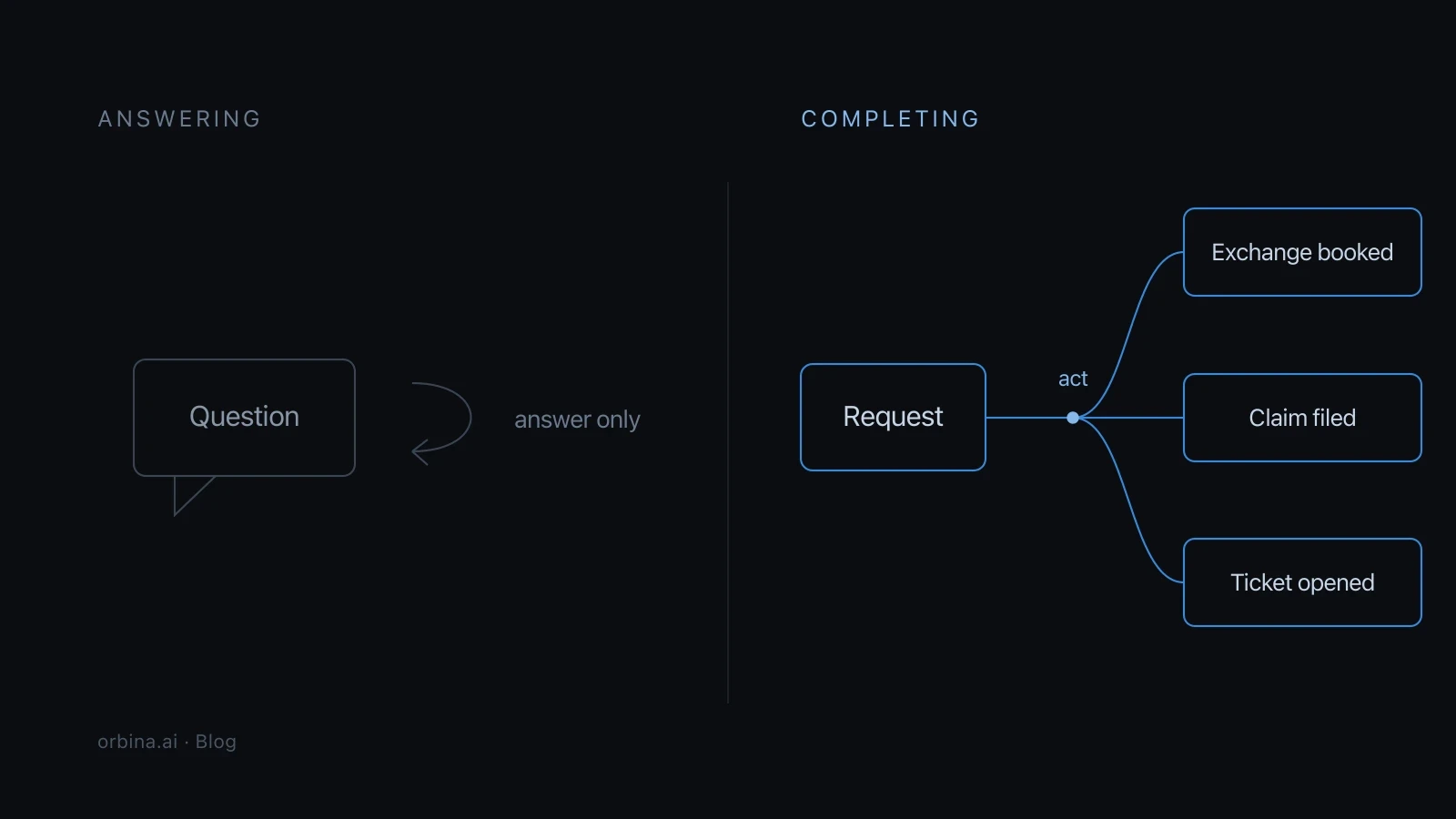
Question → Answer
The new model becomes:
Intent → Decision → Action → Outcome
This is where businesses unlock true efficiency.The Next Stage: From Support & Service to Orchestration
Customer:
“I want to return this item.”
AI Knowledge Base response:
“You can return items within 14 days according to our return policy.”
Orchestrated AI response:
Identifies the order
Checks eligibility
Generates return label
Triggers refund workflow
Updates CRM status
Sends confirmation email
Same question. Completely different value.
The Next Stage: From Support & Service to Orchestration
The future of customer experience is not just about answering questions or guiding customers.
It is about executing intent.
Modern AI systems are moving toward orchestration connecting multiple systems to:
Detect intent
Gather contextual data
Make decisions
Trigger workflows
Update transactional systems
Close the loop automatically
Instead of:
Question → Answer
The new model becomes:
Intent → Decision → Action → Outcome
This is where businesses unlock true efficiency.
AI Is Redefining Both Support and Service
AI-powered systems can now:
Automate first-line support
Provide 24/7 service
Personalize responses
Analyze customer intent
Reduce ticket volume
But the real transformation happens when AI doesn’t just respond it acts.
When AI connects CRM, ERP, payments, and logistics into a unified decision layer, customer experience moves from reactive to operationally intelligent.
That’s when support and service stop being departments and become orchestrated systems.
Customer support fixes problems.
Customer service builds relationships.
But modern digital operations require something more powerful:
Intelligent orchestration that resolves intent end-to-end.
Because customers don’t measure how well you explain a policy.
They measure how quickly you solve their need.
Frequently Asked Questions
What is the difference between customer support and customer service?
Customer support focuses on resolving technical issues, while customer service covers the overall customer experience, including proactive assistance and relationship management.
Is customer support part of customer service?
Yes. Customer support is typically considered a subset of customer service, focused specifically on troubleshooting and issue resolution.
Why is the distinction important for businesses?
Understanding the difference helps businesses structure teams, automate processes effectively, and deliver better customer experiences across the entire journey.
How is AI transforming customer support and service?
AI can automate responses, detect intent, personalize interactions, and reduce ticket volume. Advanced systems can also trigger workflows and execute actions across multiple platforms.
What is customer experience orchestration?
Customer experience orchestration connects multiple systems such as CRM, ERP, payment, and logistics platforms to detect intent, make decisions, and execute actions automatically.