What Is an AI Knowledge Base And Why It’s No Longer Enough.
Customer experience is no longer measured by how well you explain things.
It’s measured by how fast you resolve them.
In recent years, companies have adopted AI Knowledge Bases to improve self-service, reduce support load, and provide faster answers. Compared to traditional FAQs or rule-based chatbots, this was a major step forward.
But as digital operations become more complex, a new reality is emerging:
Providing information is not the same as resolving intent.
Let’s break this down.
What Is an AI Knowledge Base?
An AI Knowledge Base is an intelligent system that uses large language models (LLMs) and retrieval technologies to generate contextual responses from structured and unstructured data sources.
Unlike traditional knowledge systems, it can:
Understand natural language
Perform semantic search
Pull information from multiple sources
Generate dynamic, contextual answers
Improve through feedback loops
Most AI Knowledge Base systems rely on:
Retrieval-Augmented Generation (RAG)
Vector embeddings
Semantic search
Document ingestion pipelines
This allows users to ask questions conversationally instead of browsing documentation.
And that’s powerful.
But it has limits.
The Hidden Limitation: It Only Answers
When a customer says:
“Where is my order?”
“I want to return this item.”
“Upgrade my subscription.”
“Cancel my policy.”
They are not asking for documentation.
They are expressing intent.
An AI Knowledge Base can explain the return policy.
But it cannot:
Create the return request
Update the CRM
Trigger a refund
Modify subscription status
Notify logistics
Log compliance records
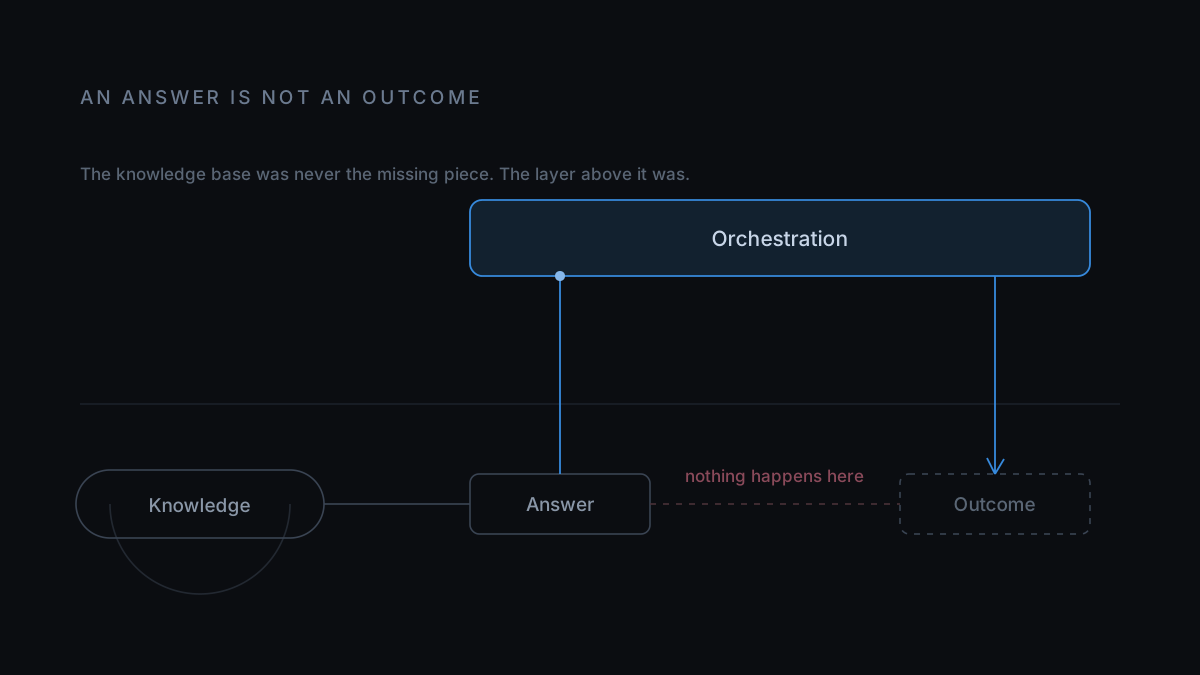
It informs.
It does not act.
And that’s where friction begins.
Why this gap matters?
Modern businesses operate across multiple systems:
CRM
ERP
Payment platforms
Order management
Logistics tools
Support systems
Marketing automation
If AI only reads documents but cannot interact with these systems, it becomes a “smart FAQ.”
Not a resolution engine.
Customers today expect outcomes, not explanations.
The Evolution: From Knowledge to Orchestration
The next generation of AI is not about better answers.
It’s about coordinated execution.
Instead of:
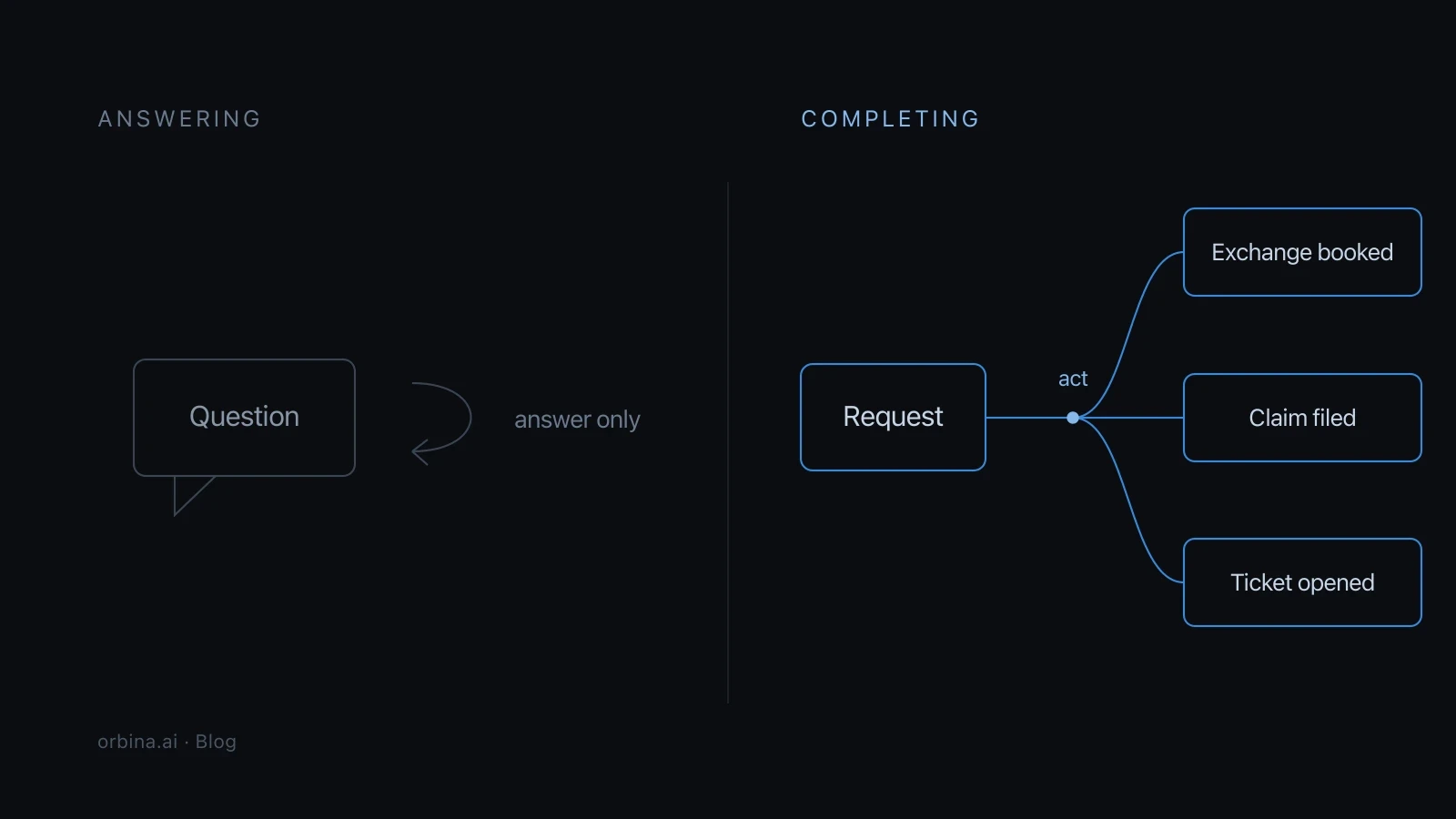
Question → Answer
The new model becomes:
Intent → Context → Decision → Action → Outcome
This requires more than a knowledge base.
It requires orchestration.
An orchestrated AI system can:
Detect intent
Gather contextual data from multiple systems
Make a decision
Trigger workflows
Update transactional systems
Close the loop automatically
This is where AI moves from support tool to operational layer.
A Simple Example in E-commerce
Customer:
“I want to return this item.”
AI Knowledge Base response:
“You can return items within 14 days according to our return policy.”
Orchestrated AI response:
Identifies the order
Checks eligibility
Generates return label
Triggers refund workflow
Updates CRM status
Sends confirmation email
Same question. Completely different value.
What to Consider Before Implementing an AI Knowledge Base
Before adopting an AI Knowledge solution, ask:
Does it integrate with transactional systems?
Can it trigger workflows?
Does it support role-based access control?
How does it prevent hallucinations?
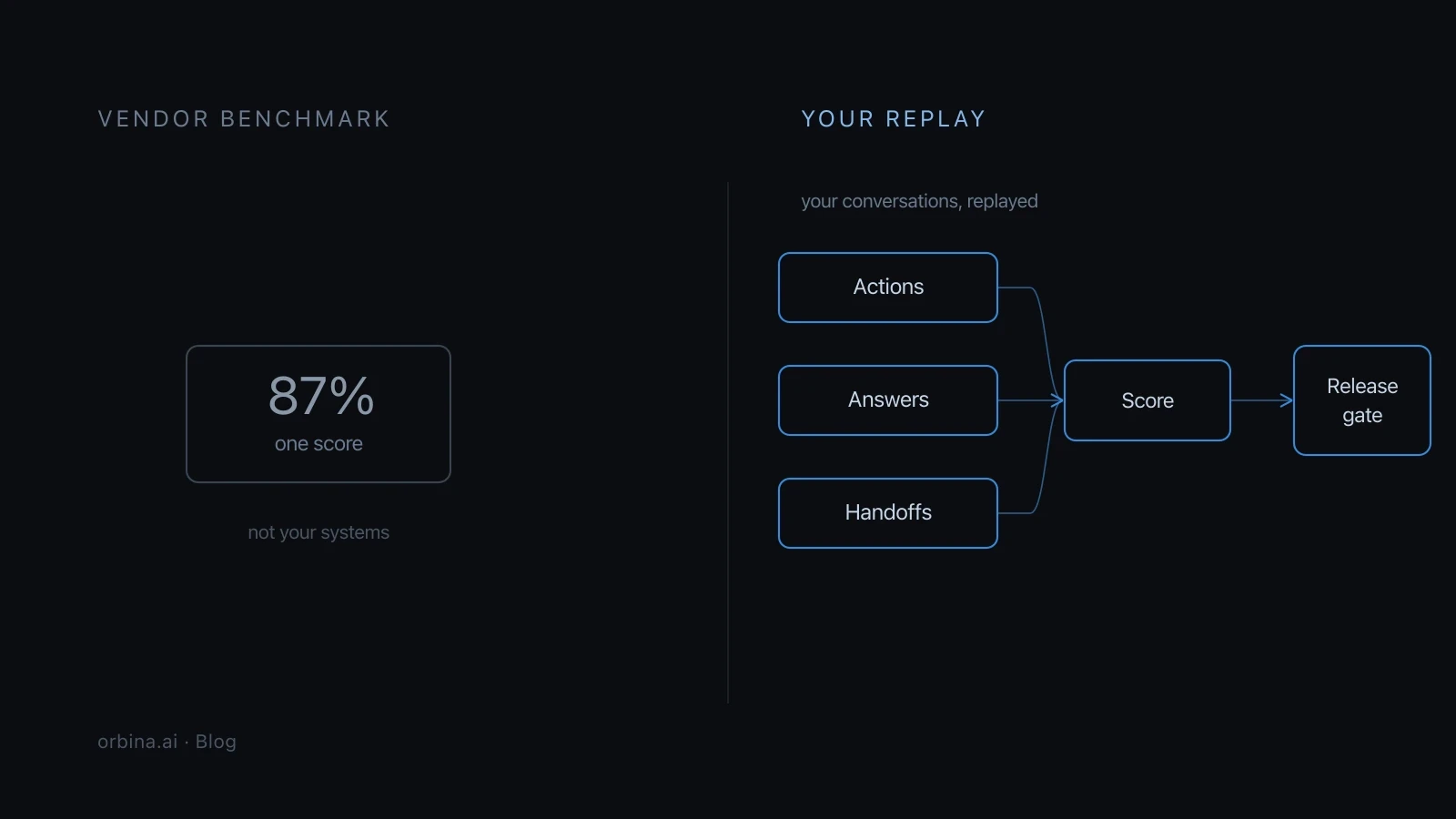
Can it measure intent success rate?
Because knowledge without action creates a ceiling on customer experience.
AI Knowledge Bases represent an important evolution beyond traditional chatbots.
But they are not the final stage.
The future belongs to systems that don’t just answer but decide, act, and resolve.
Because customers don’t measure how well you explain things.
They measure how quickly you solve them.
Frequently Asked Questions
How is an AI Knowledge Base different from a traditional chatbot?
Traditional chatbots rely on predefined scripts and decision trees. AI Knowledge Bases use semantic search and language models to understand user intent and generate dynamic responses based on context rather than fixed flows.
How does an AI Knowledge Base work?
It typically detects user intent, retrieves relevant information through vector search, assembles context, and generates a response using an LLM. Most modern systems rely on Retrieval-Augmented Generation (RAG) to combine search and language generation.
What are the limitations of an AI Knowledge Base?
AI Knowledge Bases primarily provide answers. They usually do not trigger workflows, update CRM or ERP systems, execute transactions, or perform operational actions. They inform users but do not complete processes.
What is the difference between an AI Knowledge Base and AI Orchestration?
An AI Knowledge Base focuses on answering questions. AI Orchestration goes further by connecting systems, making decisions, triggering workflows, and executing actions across platforms such as CRM, ERP, payments, and logistics tools.
When should a company go beyond an AI Knowledge Base?
If customer interactions require approvals, transactions, system updates, or automated workflows, a knowledge-based system alone may not be sufficient. In these cases, an orchestration layer is needed to deliver full resolution.