Updated 23 September 2026
AI in customer service in 2026 means two things sold under one name: software that answers customer questions from a knowledge base, and software that completes customer requests inside your systems. This guide covers both: what separates them, how they are measured, priced, deployed and rolled out.
Key takeaways
The 2026 dividing line is not model quality but write access: whether the AI can create or change a record in a system you own.
The stack has seven parts (knowledge, tools, guardrails, handoff, versioning, measurement, deployment); most failed projects skipped two of them.
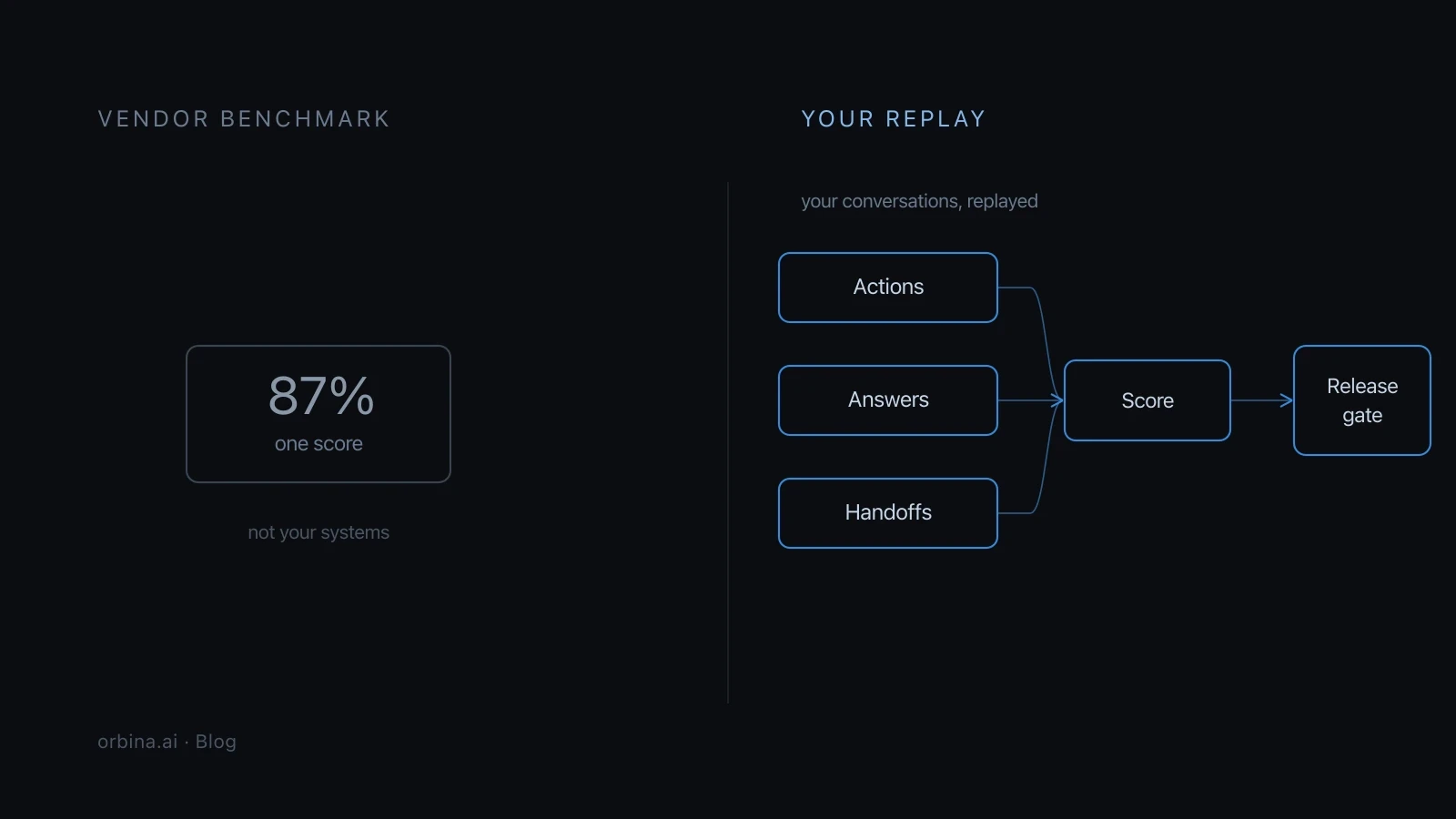
Resolution rate, the industry's headline metric, counts customer silence as success; completed transaction rate in your own system is the number to run the business on.
Published per-unit prices in 2026 run from $0.10 per session to $2.00 per conversation; custom enterprise contracts reported by third parties run $30,000–$300,000+ a year.
A first workflow can be live in weeks when scoped to one transaction type; enterprise pilots in regulated sectors follow an NDA → POC → pilot sequence that adds time before the build starts.
What AI in customer service means in 2026
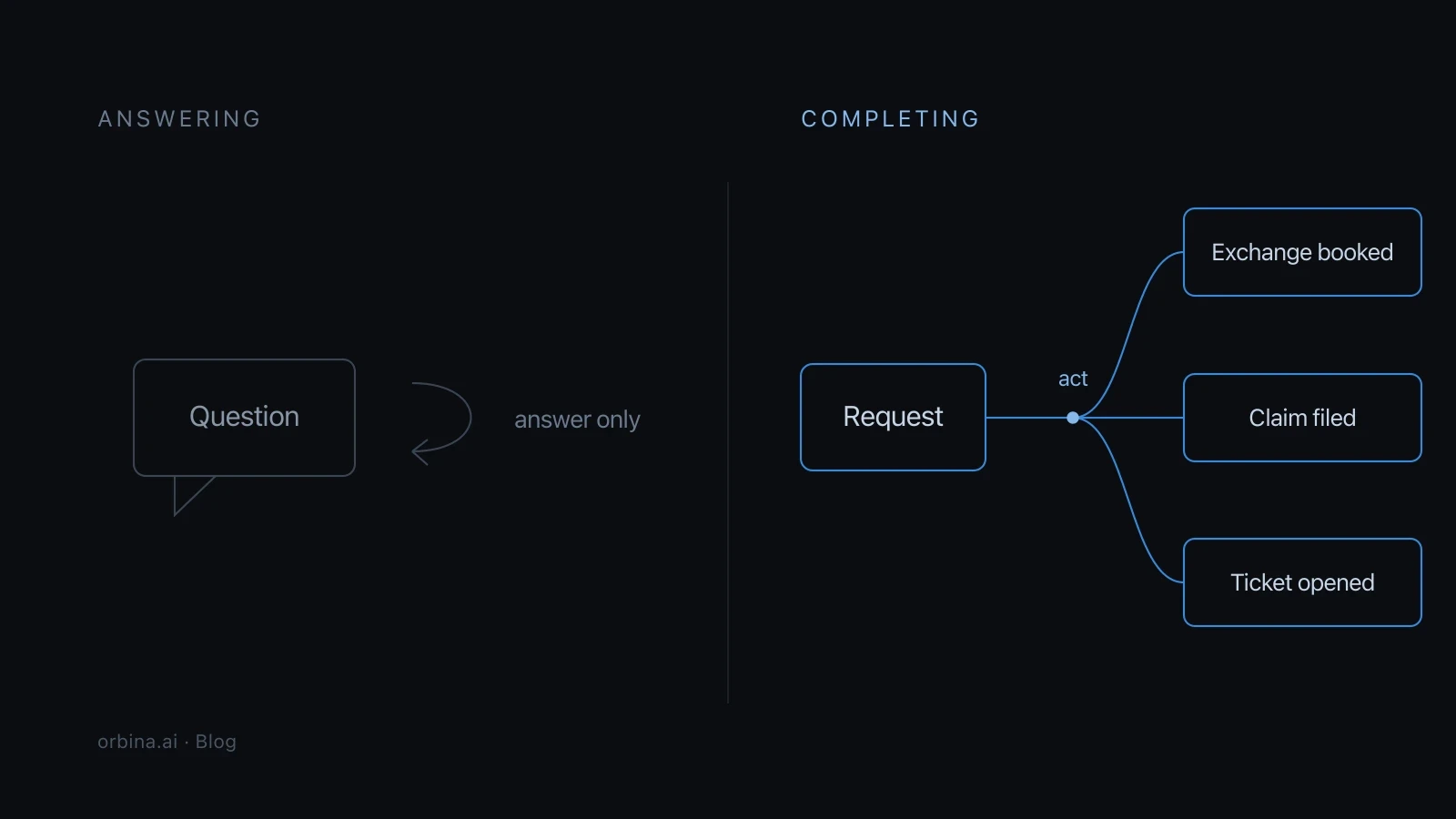
Ten years of chatbots taught customers to expect an answer. The shift of the last two years is that the software can now act: book the exchange, change the address, file the claim, open the ticket with the right fields. The market calls all of it "AI customer service"; the useful distinction is between answering and completing.
The answering layer is mature. A retrieval system over your help centre, policies and product data, with a language model writing the reply, handles most informational questions well and is available from dozens of vendors at published prices. If your support volume is mostly questions, this layer is the purchase, and the cheapest honest version of it wins.
The completing layer is where the economics change. An agent that can call your order, policy, CRM or ticketing system turns a conversation into a transaction, and a transaction is something you can count, audit and price. It is also where the risks live: a wrong answer costs a follow-up; a wrong action costs a refund, a data incident or a regulator's letter. Everything else in this guide follows from that asymmetry.
Layer | What it does | Typical unit | Where it fails |
Answering (chatbot, knowledge assistant) | Retrieves and explains | Per session or seat | Anything requiring a system change; hallucinated policy detail |
Completing (AI agent) | Reads and writes across systems | Per resolution, conversation, action, or completed transaction | Wrong action, silent failure, unbounded scope |
Caption: The two layers are usually sold on the same slide. They are bought for different reasons and should be priced differently.
The seven parts of a working stack
A customer service AI that survives its third month has seven parts, whether or not the vendor draws them that way. Projects that stall almost always skipped one of the last four, because they are invisible in a demo and expensive in production. Use this list as the spine of any evaluation.
Knowledge and retrieval. The documents, product catalogue and past conversations the agent can draw on, chunked and scored so the right passage is found and junk is kept out. Quality here determines the ceiling of the answering layer.
Tools and actions. The connections that let the agent read and write: order status, returns, appointments, policy endorsements, ticket creation. On CXOS these are typed tools with bound parameters; tools that move money are wrapped so a person approves the call.
Guardrails. Checks on every inbound message (personal data, prompt injection, out-of-scope requests) and every outbound message (policy compliance, tone, forbidden claims). Guardrails are what let a compliance team sign off on unsupervised action.
Human handoff. A designed step, not a fallback. The reason travels with the conversation and belongs to one of three kinds: the agent couldn't act, a policy rule required a person, or the customer asked for one.
Versioning and simulation. Every change to the agent is a version with a diff, can be replayed against past conversations before go-live, and can be rolled back in under a minute. Without this, every edit is a live experiment on customers.
Measurement. A metric with a denominator you can audit outside the vendor's dashboard. More on this below.
Deployment. Where the agent, its data and the model run: global cloud, in-region cloud, on-premises, or on your own model keys. For banks and insurers this is decided before the demo.
How to measure it: from resolution rate to completed transactions
The metric the industry reports is resolution rate, and in every published definition we have found it counts a customer who stopped replying as resolved. Customers also go quiet when the answer was wrong. So the headline number measures silence, and under per-resolution pricing that silence is billed.
The number to run the business on is the share of conversations that ended with a completed transaction in your own system: a record that either exists in your order or policy platform or doesn't. A Turkish mobility operator running CXOS reports the agent handling 80% of its support volume; the evidence is in the operator's ticketing system, which neither party controls.
Two supporting numbers make the metric honest. First, handoffs broken down by cause: the agent couldn't, a policy said a human must, or the customer asked. Only the first can be improved by the vendor, so the honest ceiling of any performance promise is handoff rate × the "couldn't" share. Second, first-attempt success on transactions: how often the action completed without a retry or a human correction.
Metric | What it counts | Can be gamed by | Verifiable outside vendor? |
Deflection rate | Conversations that never reached a human | Making the human hard to reach | No |
Resolution rate | Conversations where the customer didn't write again | Counting silence | Rarely |
CSAT | Survey responses from those who answered | Survey timing and sample | Partly |
Completed transaction rate | Records created or changed in your system | Nothing structural | Yes |
Handoff by cause | Couldn't / policy / customer asked | — | Yes, with logs |
Caption: Ask each vendor which rows they report and which they will write into a contract.
How it is priced in 2026
Pricing has settled into three models, and each one decides who pays when the AI fails. Per resolution charges when the vendor marks a conversation resolved, so failure is free but the vendor defines success. Per conversation or per action charges for every attempt, so you carry the cost of the 30–40% the AI couldn't handle. Per seat charges per human agent, which is predictable and unrelated to results.
As of September 2026, published rates run from $0.10 per session (Freshdesk Freddy) through $0.99 per outcome (Fin, now Salesforce) and $1.50–$2.00 per automated resolution (Zendesk) to $2.00 per conversation or roughly $0.10 per action (Salesforce Agentforce). Sierra, Decagon, Ada, Kore.ai and Cognigy quote custom contracts; third-party procurement data puts those between about $30,000 and $300,000+ a year before implementation.
A fourth model prices the completed transaction: a platform fee plus a fee per action verified in your system, with no charge for handoffs. It keeps the alignment of outcome pricing without inheriting the definition problem. Buyers in Turkey also ask three questions the global rate cards don't answer: whether conversation history retention is priced separately, whether the contract is token-based or fixed, and whether on-premises requires renting GPUs. Ask them early; the answers change the total more than the unit price does.
The full comparison of twelve platforms and the pricing deep dive are linked at the end of this guide.
Where it is being used: by industry
The same seven-part stack produces different products in different industries, because the transaction being completed is different. The pattern across sectors is consistent: start with one high-volume, well-defined request type, prove completed transactions on it in the customer's own system, then widen to the next request type only once that number holds.
Retail and fashion. Product questions, order tracking and returns on WhatsApp and web chat, with the agent reading the catalogue and writing to the order system. A fashion retailer with 40,000+ products runs these three flows in production on CXOS; the return prevention step, where the agent resolves size and fit doubts before the order ships, is where the margin is.
Insurance. Policy renewal, claims intake, endorsements and cancellations, plus document work: reading policies, endorsements and coverage tables so the agent can answer from them. A Turkish insurer runs document automation on our platform at 90% straight-through, up from 70%. Insurers' own requirement lists put policy renewal, claims management and operations (allocation, cancellation, endorsement) under one roof; that is the shape to design for.
Banking. Conversational banking inside the perimeter: balances, transactions, card operations and KYC document processing, with the model and data on-premises or in a private cloud. Deployment mode is the first question, not the last.
Mobility and apps. Lost items, trip issues and refunds, where the best handoff is often not a call centre but a deep link back into the app: show the past-trips screen within the hour, offer "call the driver" after it.
Deployment and data: four modes
For a retailer, deployment is a checkbox. For a bank or insurer it is the gate the whole project passes through, and a vendor that offers one mode has already answered the RFP. Four modes exist in 2026, and the right one is decided by what leaves your perimeter under what rule.
Global cloud. Fastest to start, cheapest to run, and fine for public information and non-personal data. In-region cloud. The same stack in a jurisdiction your regulator accepts, which in Turkey means data residency under KVKK. On-premises. Agent, orchestration and model inference inside your data centre, including air-gapped where required; a few platforms document this, most do not. Bring your own keys. The platform routes calls to a model account you control, so the provider's meter and data terms are yours.
Ask every vendor for the architecture diagram of each mode they claim, and for what data moves between boxes. If the answer is a conversation rather than a diagram, the mode is not really offered.
Implementation: from discovery to handover
A first workflow can be live in weeks when it is scoped to one transaction type, one channel and one system of record. Projects that take a year are usually scoped to "customer service" rather than to "returns for orders under 30 days on WhatsApp". The sequence that works has four stages.
Discover. Pick the workflow by volume and by how well the rule is written down. Pull last month's conversations for it; they become the test set.
Build. An engineer inside the customer's workflow (on CXOS, a forward deployed engineer) connects the tools, writes the guardrails and runs the agent against the real test set until the completed transaction rate holds.
Live. A staged rollout with a rollback ready, and the metric reported from the customer's system, not the vendor's.
Handover. The customer's team owns versions, simulations and the knowledge base, or the vendor operates it as a managed service. Decide which before go-live; the price and the staffing differ.
In regulated sectors the sequence is preceded by NDA → proof of concept → pilot, which adds calendar time before the build starts. Budget for it rather than being surprised by it.
Risks and how they are controlled
The risks of AI in customer service are specific and controllable; they are only dangerous when treated as general anxiety. Each of the four maps to a part of the stack, and the control is a log you can inspect, not a promise.
Wrong answers. Controlled by retrieval quality and outbound guardrails; measured by first-attempt success and by escalations tagged "agent was wrong". Wrong actions. Controlled by typed tools, bound parameters and human approval on anything that moves money or personal data. Data exposure. Controlled by inbound PII masking, deployment mode and retention rules; verified by a redaction log. Silent regression. Controlled by versioning and simulation; every change replayed against past conversations before customers see it.
The question to ask a vendor about each risk is the same: show me where this appears in the log.
How to decide
Three questions settle most decisions. What share of your volume needs something to happen, rather than something to be explained? What deployment mode does your data require? And what record will you use to verify results, and who controls it? Answer those before the demo, and the feature grid becomes a formality.
If most of your volume is questions, buy the answering layer at a published price and measure it for a quarter. If most of it is requests, buy the completing layer, price it on the transaction, and put the metric definition in the contract. If you are regulated, start with the deployment diagram.
The detailed guides below cover each part of the decision.
Related guides
Frequently Asked Questions
How is AI used in customer service?
In two layers: answering customer questions from a knowledge base, and completing customer requests by acting in other systems (returns, address changes, claims, tickets). Most 2026 deployments start with the first and earn the second one workflow at a time.
What is an AI customer service agent?
Software that can take actions in your systems on a customer's behalf, within guardrails, and hand off to a person with the reason attached. The test that separates it from a chatbot: could a chatbot with a good knowledge base do this? If yes, it is a chatbot feature.
What is a good resolution rate for AI customer service?
There is no comparable number, because vendors define resolution differently and most count customer silence. Ask instead for completed transaction rate in your own system and for handoffs broken down by cause.
How long does AI customer service implementation take?
Weeks for one scoped workflow with an engineer inside your systems; longer where an NDA → POC → pilot sequence precedes the build. Projects scoped to "all of customer service" take quarters.
Can AI customer service run on-premises?
Yes, on a minority of platforms. Four modes exist in 2026 (global cloud, in-region cloud, on-premises, bring-your-own-keys); ask for the architecture diagram of each mode a vendor claims.
How much does AI in customer service cost?
Published unit prices as of September 2026 range from $0.10 per session to $2.00 per conversation or resolution, on top of platform or seat fees. Custom enterprise contracts reported by third parties run about $30,000–$300,000+ a year before implementation.