Conversational AI vs Generative AI: How They Actually Differ
As AI adoption grows, two terms are often used interchangeably: conversational AI and generative AI. While they overlap in some areas, they are not the same thing.
Understanding the difference between conversational AI vs generative AI is important for businesses deciding how to improve support, automate interactions, or build more advanced digital experiences.
One is primarily focused on dialogue. The other is designed to generate new content across many formats.
This guide explains how they differ, where they intersect, and how businesses should think about them in practice.
What Is Conversational AI?
Conversational AI refers to systems that are designed to communicate with users in a natural, interactive way.
These systems are often used for:
customer support chats
virtual assistants
voice bots
support intake flows
guided digital self-service
The main goal of conversational AI is to create a responsive and useful interaction between a user and a machine.
Conversational AI often includes technologies such as natural language understanding, intent detection, dialogue management, and sometimes large language models.
What Is Generative AI?
Generative AI refers to systems that can create new content based on patterns learned from training data.
This content may include:
text
images
code
audio
summaries
recommendations
While a chatbot may use generative AI to produce responses, generative AI itself is a broader category. It is not limited to conversations.
That is why not all generative AI is conversational AI, and not all conversational AI depends entirely on generative models.
Conversational AI vs Generative AI: Key Difference
The easiest way to understand conversational AI vs generative AI is this:
Conversational AI is about interaction
Generative AI is about creation
Here is a practical comparison:
Category | Conversational AI | Generative AI |
|---|---|---|
Main purpose | Conduct dialogue | Generate new content |
Typical format | Chat or voice | Text, images, code, audio |
User interaction | Ongoing conversation | Not always conversational |
Common business use | Support and assistants | Content generation and reasoning |
Can overlap? | Yes | Yes |
The overlap happens when a conversational interface uses a generative model to respond. But the concepts remain different.
Where Conversational AI Works Best
Conversational AI is especially valuable when businesses need structured and scalable interaction.
It works well for:
customer support
appointment scheduling
account assistance
guided troubleshooting
FAQ handling
In these scenarios, the main challenge is maintaining a useful and natural interaction.
Where Generative AI Works Best
Generative AI is more useful when the goal is to create or transform content.
Typical use cases include:
writing drafts and summaries
generating product descriptions
producing code suggestions
analyzing large text inputs
creating personalized outputs
This makes generative AI highly versatile across both internal and customer-facing workflows.
How the Two Technologies Work Together
In many business systems, conversational AI and generative AI work together rather than separately.
For example:
the conversational AI layer manages the interaction
the generative AI layer creates the response
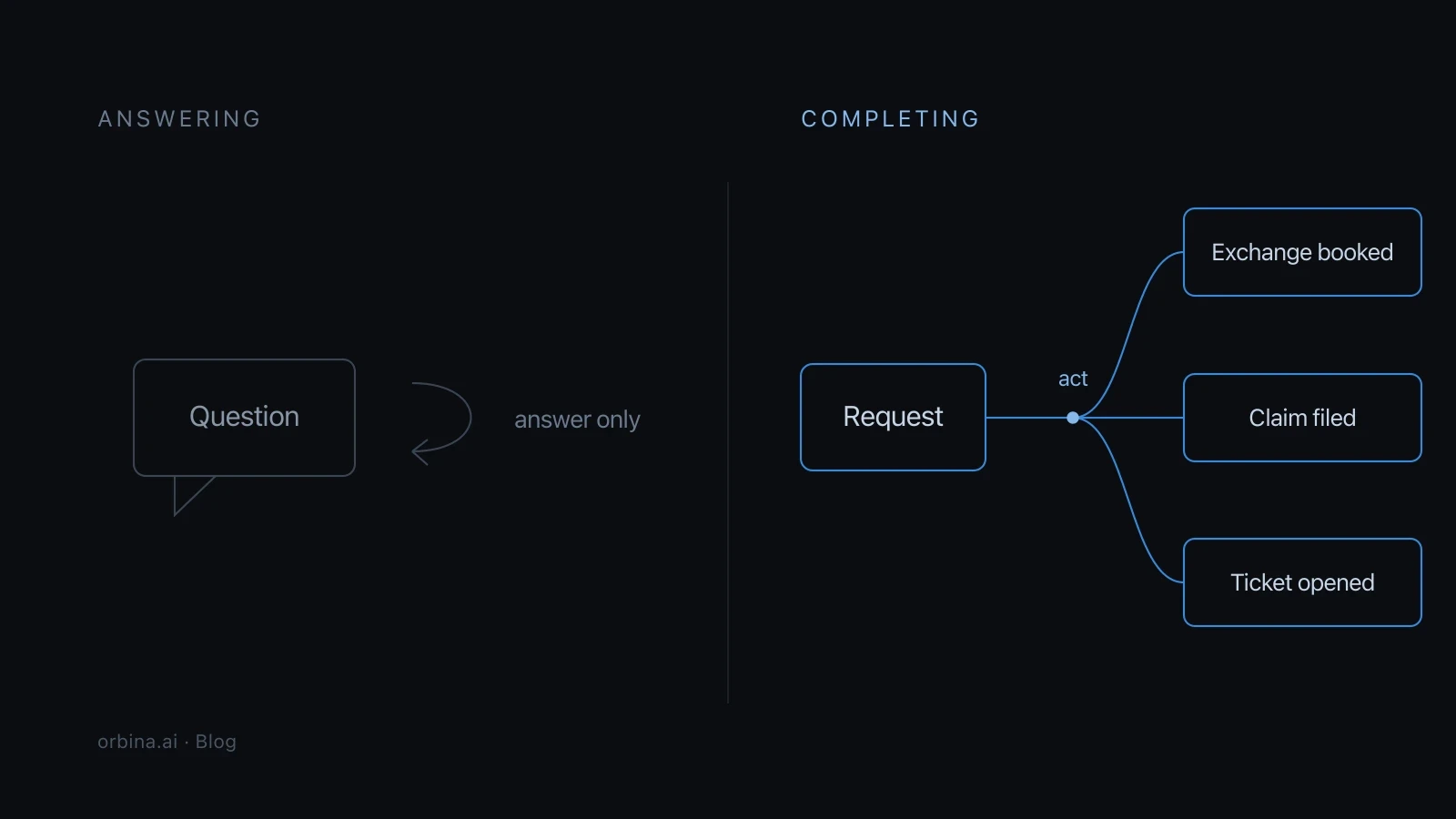
additional workflow logic determines what action to take next
This combination is increasingly common in customer operations and enterprise automation.
Why the Difference Matters for Businesses
The reason businesses should understand conversational AI vs generative AI is simple: they solve different problems.
If your goal is interaction, routing, and support, conversational AI should be the starting point.
If your goal is content creation, summarization, or dynamic output generation, generative AI is the more relevant category.
And if your workflow requires both conversation and intelligent response generation, then combining them may be the best option.
Conversational AI and generative AI are closely related, but they are not interchangeable.
Conversational AI is built for dialogue.
Generative AI is built for creation.
As businesses modernize operations, the most effective systems will often use both combining natural interaction with dynamic content generation and workflow intelligence.
Understanding that distinction helps teams choose the right architecture, not just the right buzzword.
Frequently Asked Questions
What is the difference between conversational AI and generative AI?
Conversational AI focuses on user interaction through chat or voice, while generative AI focuses on creating new content such as text, code, images, or summaries.
Is ChatGPT conversational AI or generative AI?
It is primarily a generative AI model, but when used in a chat interface, it also functions within a conversational AI experience.
Can conversational AI use generative AI?
Yes. Many modern conversational AI systems use generative AI models to produce more natural and flexible responses.
Is generative AI always conversational?
No. Generative AI can create content in many forms and does not need to operate through conversation.
What are examples of conversational AI?
Examples include customer support chatbots, voice assistants, virtual agents, and guided support workflows.
What are examples of generative AI?
Examples include text generation tools, image generators, summarization systems, code assistants, and content drafting models.
Which is better for customer support?
Conversational AI is generally the better starting point for customer support because it is designed for interaction. Generative AI may improve response quality within that experience.
Do businesses need both conversational AI and generative AI?
In many cases, yes. Businesses often combine them to deliver better support, richer responses, and more flexible automation.
Can generative AI replace traditional chatbots?
It can improve chatbot experiences significantly, but businesses still need conversation design, workflow logic, and governance around those models.
Why is the difference important in enterprise AI?
Because choosing the wrong category can lead to poor design decisions. Businesses need to know whether they are solving for interaction, content generation, or both.