What Is Intelligent Process Automation (IPA)?
Businesses have used process automation for years to reduce repetitive work. But as workflows become more complex, fixed rules are no longer enough.
That is where Intelligent Process Automation (IPA) becomes relevant.
IPA combines traditional automation with AI capabilities such as language understanding, document processing, classification, reasoning, and workflow decision support.
If you are asking what is Intelligent Process Automation, the simplest answer is this:
It is a more adaptive form of automation designed for processes that involve both execution and judgment.
How IPA Differs from Traditional Automation
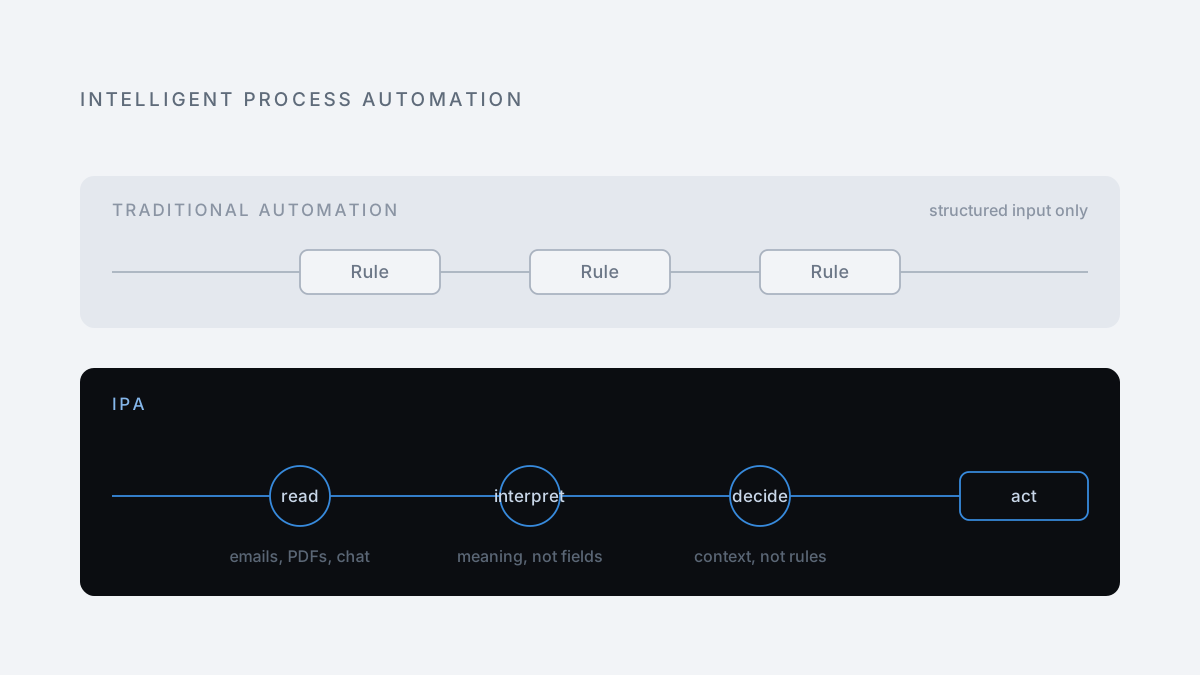
Traditional automation is highly effective when a process is stable and predictable. It works best when the steps are known in advance and the rules rarely change.
IPA goes further by helping systems handle more variability.
A typical IPA workflow can:
interpret user input
extract information from documents
evaluate context across systems
choose the next step
trigger downstream actions
This allows automation to support more complex business processes without requiring constant manual intervention.
IPA vs Traditional Automation
The difference becomes clearer when you compare how they behave.
Feature | Traditional Automation | IPA | |
|---|---|---|---|
Logic | Fixed rules | Adaptive and context-aware | |
Input type | Mostly structured | Structured + unstructured | |
Flexibility | Low | Higher | |
Best for | Stable workflows | Complex workflows | |
Decision support | Limited | Built in |
IPA is not about replacing automation. It is about expanding what automation can handle.
What Technologies Are Part of IPA?
Intelligent Process Automation usually combines several technologies together.
These may include:
workflow automation tools
robotic process automation
machine learning models
natural language processing
document intelligence
decision logic or orchestration layers
The exact combination depends on the workflow, but the goal remains the same: automate processes that require more than repetition.
Where Businesses Use IPA?
IPA is most valuable in processes that are repetitive, but not fully predictable.
Common use cases include:
customer onboarding
invoice and document processing
compliance checks
support ticket classification and routing
approval workflows with policy rules
claims handling and validation
These are not just tasks. They are processes with multiple steps, conditions, and exceptions.
Why IPA Matters for Enterprises?
Enterprises are especially interested in IPA because it helps them automate decision-heavy processes without relying entirely on manual review.
IPA can help organizations:
reduce operational bottlenecks
improve processing speed
standardize workflow decisions
increase scalability
support better visibility into process performance
It transforms process automation from a rule-based helper into a more intelligent operational layer.
IPA and AI-Driven Workflows
As AI becomes more integrated into business systems, IPA is increasingly connected to broader workflow orchestration.
In many environments, IPA sits at the center of:
input interpretation
decision routing
workflow execution
exception handling
escalation logic
That makes IPA a bridge between traditional process automation and more advanced AI-driven operations.
If you are exploring what Intelligent Process Automation (IPA) is, the key idea is simple: IPA helps automate business processes that require both action and judgment.
It combines structured automation with AI-based understanding, making it more useful in real-world workflows where variability is normal.
That is why IPA continues to grow as businesses modernize operations and move beyond rigid automation models.
Frequently Asked Questions
What is Intelligent Process Automation (IPA)?
Intelligent Process Automation is a combination of traditional automation and AI technologies used to automate business processes that require both execution and contextual decision support.
How is IPA different from traditional automation?
Traditional automation follows fixed rules, while IPA can interpret context, process unstructured data, and support more adaptive workflows.
What are examples of IPA in business?
Examples include onboarding automation, document processing, compliance validation, support routing, and approval workflows.
Is IPA the same as RPA?
No. RPA focuses on repetitive digital tasks, while IPA combines automation with AI to support broader and more dynamic process automation.
What technologies are used in IPA?
IPA may include workflow tools, RPA, document intelligence, machine learning, natural language processing, and orchestration logic.
Why do businesses use IPA?
Businesses use IPA to automate more complex workflows, reduce manual review, improve consistency, and scale operations more effectively.
Can IPA handle unstructured data?
Yes. One of IPA’s strengths is handling unstructured inputs such as emails, documents, or free-text requests.
Is IPA only for large enterprises?
No. While enterprises often use IPA for large-scale operations, smaller businesses can also use it for document workflows and support processes.
What is the benefit of IPA over basic workflow automation?
IPA supports decision-making and contextual processing, which allows businesses to automate more than just fixed tasks.
Where does IPA fit in digital transformation?
IPA plays an important role in digital transformation by making operations more adaptive, scalable, and intelligent.


